• Hello world!

    Welcome to WordPress. This is your first post. Edit or delete it, then start writing!

  • Question 1 – Where can I find the most reliable and up-to-date information about autism?

    NB Most images are hyperlinked

    and will either take you to a website or will enlarge the image to allow you to read more easily.

    Sometimes images remain invisible (I know not why!). If you think there should be an image, click where you think it should be and it will likely take you to the hyperlink.

    In this section:

    1  Resources to help you better understand autism

    2  Neurodiversity – what is it?

    3  The autistic voice – links to videos and articles by autistic people explaining what it’s like to be autistic

    4  The link between autism and and anxiety and how this can lead to masking, shutdowns and meltdowns

    5  Information about Pathological Demand Avoidance

    6  Autism and girls

    7  Stimming

    8  Anxiety related absence (School refusal)


    1  Resources to help you better understand autism

    What is autism?

    Information on those ‘thinking differences’ from the National Autism Implementation Team (NAIT)


    Sopport for our autistic learners should always be anticipatory. We should expect that they will have challenges in the highly social and sensory environment that is a school. This article from ‘Teaching Scotland’ (Page 18) explains in more detail.


    These are the resources which will give you up-to-date, reliable, evidence-based information about autism.

    Information, advice and research from The National Autism Implementation Team. The NAIT Team are professionals from Education, Speech and Language Therapy, Occupational Therapy and Psychiatry, who have considerable experience and expertise in working with autistic individuals of all ages, their families and others who support them. NAIT provide practitioner to practitioner advice.

    … from this website


    ‘The Autism Toolbox’.  A wealth of information and a resource for nursery, primary and secondary schools. Be prepared to get lost for hours!

    The Autism Toolbox


    This 13 minute video by John Simpson about autism and secondary school was made several years ago but still contains relevant information and advice. 14 minute video


    Free modules from Education Scotland.


    ‘Understanding Autism’ is a FREE online course from the University of Kent.


    ‘Understanding Autism’ from The Open University. Yet another FREE, online series of modules.


    From ‘The Art of Autism’ One of the best explanations of autism I’ve come across so far written by an autistic woman.


    Some short videos to help everyone (adults, young people and children) understand autism.

    From Scottish Autism ‘What is autism?’ 4 minute video.


    From the National Autistic Society ‘Do you know somebody with autism?’ 4 minute video.


    Really good animation ‘Amazing Things Happen’. 6 minute video.


    A ‘Newsround’ clip by Rosie King. This has been around for many years now but it’s still a great watch. 15 minute video.


    3 minute video which gives sound advice on how to talk to children/young people about their autism.


    Short article from Facebook on shy you should tell your kids they’re autistic.


    2  Neurodiversity – what is it?

    ‘The Neurodiversity Movement has its origins in the Autistic Rights Movement that sprung up in the 1990’s. The term neurodiversity was coined in 1998 by an autistic Australian sociologist named Judy Singer, and was quickly picked up and expanded upon within the autistic activist community.

    The focus of work within the neurodiversity paradigm has broadened beyond autism to encompass other forms of neurodivergence, while at the same time the paradigm has increasingly gained footholds in various realms of scholarship, literature and praxis’.

    ‘Neurodiversity is the diversity of human brains and minds, the infinite variation in neurocognitive functioning within our species. The Neurodiversity Paradigm is an emergent paradigm in which neurodiversity is understood to be a form of human diversity that is subject to the same social dynamics as other forms of diversity (including dynamics of power and oppression)’.

    (Excerpts from ‘The Neurodiversity Paradigm’ by Nick Walker)

    This illustration explains it simply …


    From the Autism Toolbox


    3  The autistic voice – links to videos and articles by autistic people explaining what it’s like to be autistic

    If you really want to understand autism and learn about the most effective strategies to use, speak to autistic people and ask them to explain their sensory differences, meltdowns, what it’s like to spend a day at school, what it’s like trying to operate in a group etc. It’s fascinating hearing their different perspective of the world. The next best thing is to listen to what autistic people have to say online. Here are links to videos of autistic people I think are brilliant at talking about their autism and helping us ‘neurotypicals’ understand what it’s like to live with autism …


    I’ve thought long and hard about including this video as Hannah uses (5 times) language some may find offensive. However, it’s so brilliant at helping us understand autistic thinking I’m going for it! Here’s a little bit of info on Hannah Gadsby:

    Growing up, Hannah Gadsby always felt she was different. She struggled to read social cues, she had trouble applying for jobs, and spent a few living in a tent and doing farm labor. But Gadsby, who’s from Tasmania, had always been funny. On a whim, in 2006 she entered a stand-up comedy competition — and won.

    “I’d never held a microphone before. … I’d never even been to a comedy show — but all of a sudden, I kind of knew what I was doing,” she says. “As soon as I told my first joke … it really made people engage with me, and I held the audience in my hand.”

    Gadsby embarked on a comedy career in Australia, but she still felt out of place. It wasn’t until 2016, when she was diagnosed with autism spectrum disorder that things started to make sense.

    “It shifted the way that I understood myself,” Gadsby says of the diagnosis. “I was always operating on the false premise that everyone saw the world like I did.”

    “People on the spectrum … sort of feel like an alien being dropped in from outer space, and you can’t quite connect properly,” she says. “Being on stage and making a room full of people laugh, felt like a connection I hadn’t been able to establish in any other environment.”

    Enjoy! She is VERY funny! 7 minute video.


    Purple Ella is an autistic woman who has made several videos where she describes her own autism. Link takes you to lots of 10/15 minute videos made by Ella.


    Dean Beadle is an autistic adult who travels the world talking about his autism to various groups. He is also VERY entertaining! 11 minute video.


    Being diagnosed with autism is often seen as a tragedy. But for Jac den Houting, it was the best thing that’s ever happened to them. 13 minute video.


    John Simpson is an academic and autistic adult. In this selection of videos, John discusses his experiences of school (positive and negative), the importance of structure/routine/predictability, friendship and communication/social skills, advice for teenagers, advice for parents/carers, anxiety, mental health and self esteem and special interests.


    2 minute video clip of Gary Newman talking about his autism.


    A 5 minute video from Chris Bonnello (a qualified teacher and tutor of children with additional support needs) talks about his report from nursery.


    Sgilti a young autistic person talking about secondary school. Great series of short videos giving us a real insight into what school is like for him.


    Some autistic young adults talk about processing speed – it’s crucial non-autistic people understand this stuff!


    If you’ve ever wondered why some autistic people have meltdowns, this may answer your question.


    4  The link between autism and and anxiety and how this can lead to masking, shutdowns and meltdowns

    Anxiety is likely to be the overarching emotion experienced by an autistic person. Research informs us that anxiety disorders are substantially more common in autism than in the general population (10 – 15% of the general population and at least 40% of autistic people). They may express their anxiety through behaviour that challenges us. That might look like defiance, avoidance (including school), over planning, difficulty focusing, sore tummies and headaches, difficulty managing emotions etc. which may eventually result in a ‘meltdown’. Or you may see nothing which may be ‘shutdown’.

    The child may be masking their autism and/or anxiety in school. Autistic girls are significantly under diagnosed and one of the reasons for this is they are skilled ‘maskers’ (boys mask too!). Masking is exhausting and anxiety provoking for an autistic child or young person meaning they may meltdown/shutdown at home. This situation is difficult for all involved as the child/young person may be ‘holding it together’ in the very environment which is significantly contributing to their anxiety. If this happens to be the case, it’s understandable that staff  perceive they are ‘doing fine’ which can be very frustrating for parents/carers.

    It cannot be stressed enough that anxiety is reduced in an environment which is highly visual, structured, predictable and ensures sensory differences are addressed. Remember … autism is a communication difficulty so they may not communicate their anxiety either effectively or appropriately.

    Understanding that anxiety presents itself in many ways helps to explain behaviour that challenges us (what we are now referring to as distressed behaviour).


    This article explains why many autistic children and young people are ‘fine’ in school but meltdown at home.


    A MUST read. Autism, anxiety and the impact on parents. Like the author, I hear similar stories almost every day of my working life.


    Some more information on anxiety, masking, meltdowns and shutdowns.

    Information and advice from the National Autistic Society on autism and anxiety in school.


    A great short read from Sarah Henedrickx (an autistic woman, autism consultant and author) about autism and anxiety in the classroom.


    Research findings from The Autism Research Group. Easy to read and current, sound advice.


    Sarah Hendrickx (an autistic woman, autism consultant and author) talking about how anxiety affects everything. 45 min. video but well worth watching.


    Two videos (10 and 15 minutes long) from Purple Ella talking about meltdowns and what to do if you are with an autistic person in meltdown.


    A Purple Ella video about shutdowns.


    A blog about masking.


    A video about masking.


    5  Information about Pathological Demand Avoidance

    PDA is now more recognised as a distinct profile of autism. Individuals with a PDA/EDA (alternative terminology: Extreme Demand Avoidance) profile will share similar difficulties to others on the autism spectrum (triad and sensory). In addition, the central difficulty for people with PDA is their “anxiety-driven need to be in control and avoid other people’s demands and expectations.” Understanding PDA in Children. Christie, Duncan, Fidler & Healy (2011). It is the Autism which underpins the extreme demand avoidance and need for control. Because PDA is not currently included in either of the diagnostic manuals (DSMV and the ICD11), the validity of this profile of ASD remains a contentious subject among some professionals.

    Features of PDA …

    • Resisting and avoiding the ordinary demands of life – getting up, joining family meal, even when it’s what the person wants to do.
    • Use social strategies as part of the avoidance.
    • Compliance on ‘their terms’.
    • Appearing sociable on the surface.
    • Excessive mood swings and impulsivity.
    • Lack of constraint by social norms or sense of hierarchy.
    • Comfortable in role play – reality and pretence merge and blur.
    • Threats or extreme behaviour.
    • Lack of sense of responsibility or sensitivity to others’ distress.
    • Failure to constrain behaviour in public.
    • Obsessive behaviour – often social in nature.

    What this might look like …

    • Can be controlling and dominating, especially when anxious and are not in control of their environment.
    • Can also be very affectionate, charming, sociable and chatty, when they are calm and feel safe. This conflicting and variable presentation is confusing for parents and professionals alike.
    • Sometimes a child with PDA can appear very anxious at home but remain relatively passive at school (masking).
    • Demands at school can lead to severe ‘meltdown’.
    • Some children can experience such high anxiety in school that they become school refusers.
    • Just as with ASD -> experience over or under-sensitivity in any, or all, of their senses: sight, smell, taste, touch, hearing, vestibular, proprioception or interoception.
    • Seen in people of both genders and in equal proportions. No prevalence rates for PDA yet. As more diagnoses of PDA are made, prevalence figures will become more apparent.

    A half hour podcast for parents but very useful for professionals t00.


    The most reliable and evidence based information is to be found on the PDA website.


    PDA information from the National Autistic Society.


    10 minute video by a mum of a girl with PDA. Pathological Demand Avoidance (PDA): Characteristics and Strategies.


    Information and Advice from two inspirational practitioners. In this PDA Society webinar Phil Christie and Ruth Fidler from Autism Associates provide an overview of the education and support needs of children with the PDA profile. They outline how some of the strategies that are typically found to be effective for autistic children and young people (such as the use of routine, predictability and structure) need considerable adaptation, as PDA individuals respond better to less direct and more collaborative approaches.


    An 8 minute video which gives real life insight into PDA.


    Purple Ella talks about demand avoidance.


    Some starting points for school staff:

    • Quality of relationship is key. The opposite of anxiety isn’t calm … it’s trust.
    • Identify a quiet space (with child/young person if appropriate).
    • Show respect – kids should know you like them unconditionally.
    • Build in flexibility and choices to timetables – sense of autonomy. Balance – 2 options – offer to whole class?
    • Think ahead/plan for change. Give child advanced warning.
    • Work with special interests. Their special interest is your most valuable tool.
    • Keep calm! PDA kids are adept at reading reactions -> your reaction may motivate!
    • Be willing to apologise. No relationship – no progress.
    • As few ground rules as possible – pass over responsibility ‘I’m sorry it’s health and safety’ or ‘It’s on the timetable I’m afraid’.
    • Use complex language? Can sound more negotiative and may intrigue.
    • Humour can help.
    • Monitor stress levels – scale back demands if necessary.
    • Indirect language. ‘I wonder if we can …?’ ‘Maybe we could investigate …?’ etc.
    • Use distraction.
    • Ask for advice!

    An adult writing about her PDA.


    6  Autism and girls

    • Previously thought fewer females on the spectrum.
    • It is now recognised from research, clinical practice and anecdotal reports that many autistic females are not being recognised. This can result in misdiagnosis, late diagnosis, or women and girls not being diagnosed at all.
    • Some say the diagnostic criteria for autism are biased towards the behaviour of men and boys.  ’Diagnostic tools … were developed according to male phenotypes’ (Gould and Ashton-Smith, 2011). Whatever the reasons, we know that autistic women and girls are still hugely misunderstood.
    • More subtle presentation -> barrier to clinicians and other professionals.
    • It’s still more common for men and boys to receive a diagnosis of autism. Increasingly believed autistic women and girls may be better at masking their difficulties -> autism missed.
    • It seems that girls on the autism spectrum may be less noticeable than boys because they are less disruptive and have an ability to mimic behaviours (Attwood, 2012).

    The general consensus is that females with ASD exhibit:

    • Increased social imitation skills
    • A desire to interact directly with others
    • A tendency to be shy or passive
    • Better imagination
    • Better linguistic abilities developmentally
    • Interests that focus on animals or people
    • Masking!

    From ‘Right Click’, an online resource from Scottish Autism.


    A 20 minute interview with Dr. Judith Gould from the National Autistic Society 2015 Women and Girls conference. Still relevant today.


    An online module from the National Autistic Society. Great resource. Cost £30


    7  Stimming

    Information from the National Autistic Society


    A visual from NLC Communication Friendly


    8  Anxiety Related Absence (School refusal)

    Advice for school staff from The National Autism Implementation Team for those autistic learners who are experiencing anxiety related absence and are unable to return to school.


  • Question 2 The Sensory Environment. How can I make it more inclusive?

    In this section:

    1 What we mean by ‘sensory differences’. Information on our 8 sensory systems – what they are and how they are impacted in autistic people

    2 What is stimming?

    3 Videos demonstrating what it might feel like to experience sensory overload

    4 Sensory checklists to download

    5 What is a ‘sensory diet’?

    6 Don’t know what the learner’s sensory differences are?


    A indicates images that follow are hyperlinked

    1 What do we mean by sensory differences?

    NB Sensory differences are not particular to autism.

    According to the research organisation Autistica, 9/10 autistic people have difficulty processing everyday sensory information. It should be noted that sensory differences are not particular to autism. Any of the senses may be over (hyper) or under (hypo) sensitive (or both) at different times. We are beginning to understand the significant impact sensory differences have on many autistic peoples’ ability to function day to day.

    Dr. Tony Atwood, who has been working in the field of autism for almost 40 years, informs us  ‘Some adults … consider their sensory sensitivity has a greater impact on their daily lives than problems with making friends, managing emotions and finding appropriate employment’. These sensory differences can affect behaviour and can have a profound effect on a person’s life. If not addressed, sensory differences can result in meltdowns or shutdowns.

    Introducing a ‘sensory diet’ (see below) may be a way of reducing a child/young person’s anxiety and can help reduce or even prevent meltdowns/shutdowns.


    What do the key documents say?

    P5 ‘For all aspects of learning, consideration should be given to each learner’s sensory profile’.


    P5 ‘ Consideration is given to each child’s sensory preferences.’


    P14 ‘Working within an inclusive classroom … some learners may require the use of agreed sensory supports.’


    … and includes a helpful video from an OT.


    As outlined in the video above, we all possess 8 sensory systems.

    1. Visual system (sight) – responsible for seeing.

    2. Gustatory system (taste) – responsible for our sense of taste.

    3. Olfactory system (smell) – responsible for processing smell.

    4. Tactile system (touch) – processes touch information from the body.

    5. Auditory system (hearing) – responsible for hearing.

    6. Vestibular (balance) – helps us to maintain balance and posture and understand where and how fast our body is moving.

    7. Proprioception (body awareness) – helps us know where our body is in space and how different body parts are moving in relation to each other. It’s the reason you can switch your alarm clock off without looking!

    8. Interoception – tells us what’s happening inside our bodies (hot, cold, thirsty, need the loo, feeling happy, sad, angry). This 12 minute video explains more about interoception. It’s fascinating!

    A 2 minute video explaining interoception.


    Great short article on sensory processing differences.


    A booklet produced by Falkirk Council for parents/carers but equally useful for schools. I’ve recommended it to so many people over the years.


    Great website from Glasgow City Council which includes a short videos explaining sensory differences and an online tool to help work out what a learner’s sensory needs are and how to address them. Developed for parents but very helpful for practitioners too.


    This was posted on Facebook by the mum of a child I once worked with. He had a meltdown because this little piece of fluff was in his sock. His tactile system is hyper sensitive and, to him, it was unbearably painful.


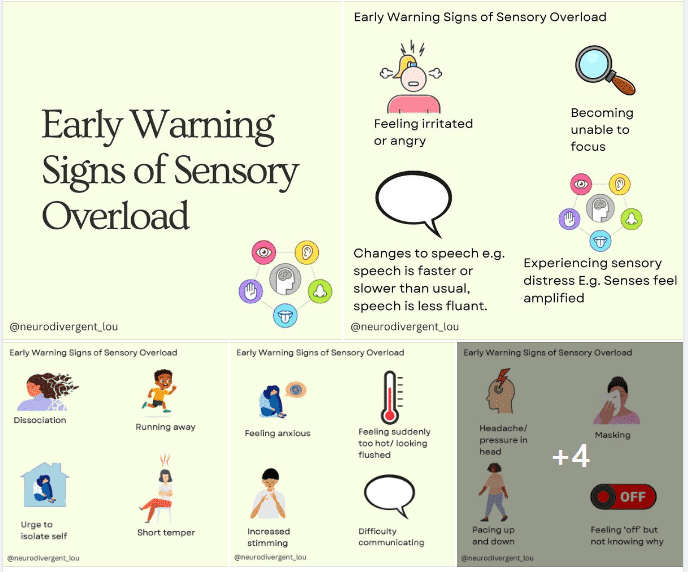
    I LOVE Neurodivergent Lou’s Facebook page. Here’s what they have to say about sensory differences:


    Autistic people say … ‘no, we won’t ;just get used to it’. It hurts!’.


    2 What is stimming

    Short article from NAS.


    3 Videos demonstrating what it might feel like to experience sensory overload

    The following videos help us understand what sensory processing differences/sensory overload/too much information can feel like. As you view the videos please keep in mind – they are not fantasy. They are likely the everyday reality for the autistic learner you are working with.

    This 3 min. video with Dr. Xander explains sensory differences so clearly.


    This 3min. 15sec. YouTube video was made by an autistic teenager to help others understand what sensory differences feel like. It’s simply a walk down the street. After viewing, reflect on what those sensory differences might feel like if the film were made in a classroom, the playground, a school corridor, shops, a party etc.


    Scottish Autism produced this video (less than 2 mins.) to help explain sensory differences.


    A video illustrating what it can feel like to be autistic.

    … and some more info about the making of the above video.


    3 Sensory checklist to download

    Sensory checklists, completed with parents, can help you identify what a child’s sensory differences are. Sometimes when you understand what the sensory differences are it is obvious how to support them, how to adapt the environment or which activities to try. For example, if they are over sensitive to light, reduce fluorescent lighting and perhaps use dimmer switches or lamps, adjust blinds etc.  I have used both of these checklists in the past and found them helpful in helping work out what a learner’s sensory differences are.

    From Autism Understanding Scotland (‘Downloadable Documents’ are hyperlinked below):


    4 What is a ‘sensory diet’?

    If you can, enlist the help of Occupational Therapy. They are the experts on sensory differences and can often carry out a sensory assessment then offer strategies. Here’s a mum’s advice to other mums on Facebook about a sensory diet recommended for her child after working with OT …


    … and some info on sensory diets.

    When you have an understanding of the learner’s sensory differences, you can begin to introduce a ‘sensory diet’ (i.e. some activities and/or adaptations during the day) as it can be a way of reducing a learner’s anxiety and reducing or even preventing meltdowns/shutdowns. This short video explains what we mean by a ‘sensory diet’.


    Sensory Circuits are such a great way of helping learners remain calm/stay regulated/get rid of energy etc. This short video explains how to do it. Add it to their daily routine. You draw the first one then learners could add their own favourite activities. Could kids design circuits for each other? Also teaches number skills, literacy skills, sequencing skills, concentration… Words could be replaced with pictures. You’ll come up with so many more ideas I’m sure.


    Advice from NAIT on providing a sensory diet – they call it ‘movement breaks’.


    Some ideas of reasonable adjustments schools can make for autistic pupils’ sensory differences.


    5 Don’t know what a learner’s sensory differences are?

    Occupational Therapists tell us that if you are not sure what a child’s sensory differences are, ‘heavy work’ activities can be effective in calming our sensory systems. Here are activities that can easily be introduced into school. They may even be part of a child’s daily timetable or may be activities they carry out in their quiet space or as part of their ‘jobs’ in school.

    Some advice and a free downloadable A4 visual. Explains what we mean by heavy work and gives some examples of activities for home and school.


    Another free printable which also includes a short video explaining what ‘heavy work’ is.

    Some ideas for parents to try at home.


    Ever thought of introducing sensory boxes?


    Just LOVE this idea. Probably against all health and safety rules!


    A neurodivergent adult I know (a promoted teacher) attending a 2 hour online training from their desk at work whilst simultaneously preparing a newsletter. They made their own adjustments – headphones on, comfy ‘nest’ under desk (fashioned from their winter coat) – in order to get the tasks of the day completed successfully. I can guarantee you they will have been completed to a very high standard!


  • Question 3 How can I make learning more meaningful?

    In this section … a closer look at:

    1 Communication and autism

    2 Autism and motivation

    3 Thinking styles


    What do the key documents say?

    It is important to match activities and expectations to each learner’s profile. The biggest reason for the distressed behaviours that we see is the mismatch between expectations and a learner’s developmental stage. For all aspects of learning, consideration should be given to each learner’s developmental stage, communication, sensory profile (see Question 2) and motivation.


    Consideration is given to each child’s:

    • developmental stage

    • communication preferences

    • sensory differences (see Question 2)

    • motivation – what is desirable to them?

    • thinking style


    P15 Many learners may have difficulty with understanding instructions or the complexities of language used. Consider differentiating language and instructions as a routine part of your practice.

    P15 Communicating clear and consistent expectations will help learners to understand what you would like them to do.

    P17 Focussing on motivation can be a powerful way of engaging interests in activities. Each learner will be motivated by different things which may vary from day to day.


    A indicates images that follow are hyperlinked

    1 Communication and autism

    The first 3 slides from one of my sessions as an intro. For information on how to support emotional expression see Question 9 – How can I better support emotional understanding.

    The following slide is hyperlinked


    ‘Autism affects the way a person communicates and interacts with (usually non-autistic) others, how information is processed and how the person makes sense of the world’ (Meeting the Needs of Autistic Learners, GTC Scotland)

    Communication is a core difference in autism. Often, an autistic pupil can give the appearance of having ‘mastered’ communication. However, it’s important to understand that the more verbal an autistic person is, the more their underlying difficulties with communication and interaction are hidden.

    The children/young people we work and live with can seem articulate and appear to have good language skills. For many, however, their ability to understand language and use it in a social context (to express thoughts, needs etc.) can be impaired. They might talk extensively about their own interests, but have difficulty starting and maintaining a conversation on other topics. Consider using visuals to give them a voice (see examples below).

    Autistic people can find it incredibly difficult to express (using the spoken word) their wants and needs; from a non-verbal child struggling to express their desire for a drink to a teenager finding it hard to express their opinion. This can result in overwhelming feelings such as anger and frustration, leading to a meltdown or shutdown.

    An autistic person’s ability to understand or use spoken language  can depend on their anxiety or stress levels. For example, someone who is normally able to communicate well may have reduced ability due to underlying anxiety or sensory needs.

    Communication and social skills often need to be explicitly taught and practised.


    This visual illustrates well what communication can be like for an autistic person. It seems a little ‘over the top’, however, many autistic adults have confirmed that this is what everyday communication is like for them. (Click on the image for a clearer view).


    A real life example. I came across this question on Facebook on an autism page. An autistic adult asking for advice, illustrating just how difficult it can be to access their ‘voice’ at times which is known as ‘situational mutism’.


    7 minute video in which an autistic adult describes what situational mutism is like for him.


    A short article on situational mutism (we used to call it ‘selective’ mutism).


    2 Double Empathy problem

    Dr. Damien Milton (an autistic academic) is introducing us to the idea of ‘double empathy’ when we think about communication with an autistic person. The dictionary definition of empathy is ‘the experience of understanding another person’s thoughts, feelings and condition from his or her point of view, rather than from one’s own’. Dr. Milton states ‘Simply put, the theory of the double empathy problem suggests that when people with very different experiences of the world interact with one another, they will struggle to empathise with each other’. The following article explains more. In other words, if autistic people have difficulty empathising with non-autistic people, it follows that non-autistic people have difficulty empathising with autistic people.


    Easy English version explaining double empathy


    Published in SAGE in 2020, research from Edinburgh University examining the double empathy theory.


    Being diagnosed autistic is sometimes seen as a tragedy. But for Jac den Houting, it was the best thing that’s ever happened to them. 13 minute video. Near the end, Jac discusses double empathy.


    2 How we can support children/young people to communicate

    Some examples of how to use visuals to support communication.

    Talking, drawing and writing at the same time can be very useful since it makes communication visual and permanent. Incorporate speech and thoughts bubbles. Please note! This is NOT the same as ‘talking and drawing’ – a child-centred therapy focusing on prevention, early intervention and recovery of mental health issues.

    This is how I illustrated a conversation I had with a P7 boy. Recording conversations like this gives children/young people time to process what has been said. It frees up ‘head space’ to allow them to focus on the content of the conversation and to reflect. It also allows you to go back to the conversation at a later date and pick up where you left off.


    Use Social Stories and Comic Strip conversations if you want to turn your ‘visual conversations’ into a learning opportunity. A comic strip conversation uses simple drawings to visually outline a  conversation between two or more people who may be reporting the past, describing the present or planning for the future. This ‘tool’ is an effective way of supporting difficulty with theory of mind and is great of providing that ‘script’ that autistic people just don’t have.


    2 booklets explaining how to use comic strip conversations.


    33 minute video from Flourish Specialist Education Services on how to use comic strip conversations.


    I regularly use an approach based on ‘The Incredible 5 Point Scale’ and ‘Talking Mats’ (a tool that facilitates communication – I have had formal training) with children as it’s an easy way to quickly gather their thoughts and opinions without having to rely on ‘traditional’ communication methods (i.e. words) which, at times, can be so inaccessible for autistic children, young people and adults.

    Some examples I’ve used. Depending on the age and stage of the young person, you may have to model how to use this approach. I often use favourite foods, favourite films, favourite games etc. For example, I might ‘ask’ do you like pizza, broccoli, fish fingers …

    This was used after staff and parents had been asking this young person what made them anxious at school. He simply wasn’t able to use the spoken word to answer. I knew this young person quite well and, with help from parents and staff, made a list of and cut up potential reasons for his anxiety. Rather than ask him if, for example, homework was a stressor, I simply read and handed him the piece of paper with ‘homework’ written on it. He immediately placed it firmly in the ‘yes’ column. Even without prompting, he intuitively knew that something he wasn’t sure of or wasn’t too much of an issue should be placed somewhere in the middle. It’s a way of quickly and efficiently getting to the core of a problem.

    This young person was struggling with homework and we didn’t know why. This approach helped identify what the issues were which we were then able to act on.

    Thursday’s were problematic for this young person. Parents were unable to get him to school on any Thursday but he couldn’t tell anyone why.


    From do2learn.  A checklist which uses a 1-5 scale to help children identify school triggers rather than ask them ‘what’s wrong?’ or ‘why don’t you like school?’ which is unlikely to be effective. Great for upper primary and secondary. If the wording isn’t appropriate for a young person I just scribble it out and write something else in.

    Examples of completed checklists …


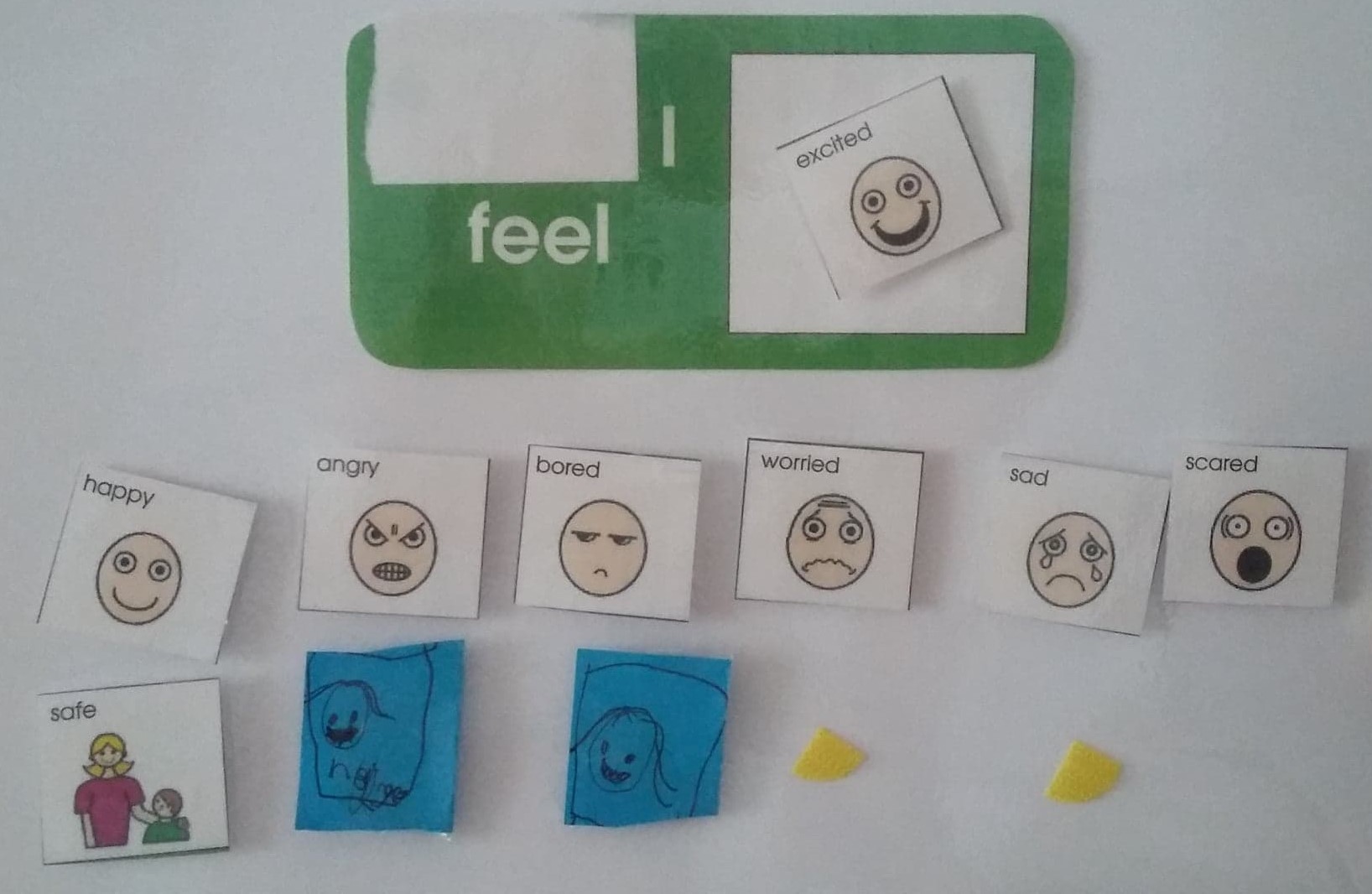
    I used this resource to support a P1 girl to communicate to staff how she was feeling at particular points in her day. She added some of her own feelings.


    Visuals to support communication when things go awry. Sometimes having that 1-1 chat can be too overwhelming for some learners as well as relying heavily on the spoken word. Using visuals like this can seem less intimidating and more collaborative, provides a structure to the conversation and makes the spoken word both visual and permanent which supports language processing and working memory.


    I quickly pulled this together to help a child communicate his opinion on how information about his autism should be delivered to his class. His mum had previously told me if folks use words alone, he is not able to communicate his opinion.


    This particular (very bright) P7 boy found it impossible to use words to communicate whether he needed help or not. This worked like a dream as all he had to do was place a piece of blu tac on the appropriate wording as he worked through his plan …


    This is a combination of a 5 point scale and talking mats I used to help gauge how different things made this child feel.


    Use visuals to help children and young people communicate feelings/emotions. These are some examples I’ve either used myself or have downloaded from elsewhere. Sometimes a child needs to see a visual once and they have the framework or ‘script’ in their head forever. Other children need to see the visual regularly, or have several copies in different places, or a folded copy in their pocket or may need to have its use modelled to them by an adult. Don’t assume that because a child is highly verbal they don’t need visuals.


    Some more ideas to give autistic children/young people a voice:


    NLC communication Friendly have some fabby visuals  to support the learner to have a voice.


    It’s a good idea to teach children how to use speech and thought bubbles to communicate. Have a ready supply in your class or at home and teach them how to use them.


    3 How we can adapt our communication to support understanding?

    This article includes advice from the National Autistic Society on how we can adapt our communication when interacting with autistic children and young people.


    From The Hanen Centre – the four ‘S’s to help you remember how to adapt your language to make it easier for autistic (all?) learners understand the spoken word.

    Say less – reduce your language. Say what you mean and mean what you say.

    Stress – stress the key words which convey meaning.

    Go slow – slow down your rate of delivery. Pause between sentences. Count to 6 in your head.

    Show – where possible, use visuals to support your language (gesture, objects, pictures, photographs … )


    2 Autism and motivation

    (Click on image to enlarge)


    3 Thinking styles

    Great article from Embrace Autism. 10 min. read.


    A visual approach is always helpful for those with different thinking and processing styles. Some examples from Communication Friendly.

  • Question 10 What’s helpful to share with parents/carers/learners?

    In this section:

    1 Information/resources for parents

    2 Information/resources for learners


    A indicates images that follow are hyperlinked

    1 Information/resources for parents

    Enquire is the Scottish advice service for additional support for learning. It contains invaluable information for parents, children and young people and professionals.

    Their mission is to:

    • raise awareness of children’s rights to extra support in school

    • help families and schools work together to ensure children get the support they need

    • provide advice to children and young people who might be struggling in school


    Salvesen Mindroom is an Edinburgh-based chartiy operating across Scotland. I’ve worked with them on and off for the best part of 20 years and currently deliver some of thier training sessions.


    Information from the National Autism Implementation Team for parents

    A Quiet Space at home:

    Movement breaks at home …

    Autistic masking …

    Supporting eating and drinking. Often a huge worry for families.


    For parents/carers whose children are struggling to get to school. This resource was produced as advice for schools (to help return learners after after Covid) but still relevant. I’ve shared it with many parents and carers who have found it helpful.


    Great advice around the demand of sleep from Laura Hellfeld’s Facebook page.


    Homework advice from The National Autistic Society


    A home timetable from ReachoutASC


    Some visuals to download from National Autism Implementation Team for using at home (or anywhere).


    3 minute video which gives sound advice on how to talk to children/young people about their autism.


    A great workbook to help children understand their autism. In the website page, scroll to the bottom of the page and register (for free) to receive the workbook


    Some great info. on autism and puberty.


    You might find these resources from Sheffield NHS helpful.


    and


    You might find this helpful


    2 Information/resources for learners

    This is part of the Enquire website for young people. Full of fantastic advice and information!


    ‘My Rights, My Say supports children aged 12-15 to use these rights. It’s independent, confidential and easy to use, and here to make sure the voices of children with additional support needs are heard.’


    Nowadays, there are almost too many books to support learners understand their emotions. This book has been around for years but still a goodie!

    Found this video to use with learners …

    may also be helpful …


    ♥ From communication Friendly – some breathing exercises to help reduce anxiety and calm the nervous system.

    ‘Krysten Taprell has very kindly given us permission to visualise some of the amazing breathing techniques she discuss on her blog. https://www.thetherapistparent.com/blog/

    Karen Taprell says on her blog that when we slow our breathing down and keep it in rhythm then the body will follow.  She also says that being anxious, leads to a flight/flight reaction which can stimulate the Vagus Nerve. If breathing can be controlled then a message is sent to this nerve which causes the body to release calming chemicals.


    From Communication Friendly. ‘We have mentioned in previous posts about the importance of using visuals to support independence. We have also looked at the importance of breaking down instructions. To help with this, we are making some resources to visualise activities to promote independence in helping around the house.’

  • Question 9 How Do I Support Emotional Understanding?

    In this section

    1 Autism and emotional understanding

    2 Resources to support teaching of emotional understanding


    A indicates images that follow are hyperlinked

    What do the key documents say?

    P5 ‘For all aspects of learning, consideration should be given to each learner’s … developmental stage’. This includes their emotional developmental stage.


    P5 ‘Consideration is given to each child’s … developmental stage.’ Again, this includes their emotional developmental stage.


    P21


    For us all, understanding our emotions is a developmental and lifelong process. It’s a journey that can be difficult for many people but it can be so much more difficult for those who are neurodiverse, particularly those who are autistic. Most of us learn almost intuitively to recognise, name, grade, understand and express our emotions. It’s not necessarily the same for neourodiverse/autistic people who often benefit hugely from having these skills taught in a structured, concrete and literal way. People who can manage their own emotions are able to:

    1. be aware of/recognise the internal sensation of the emotion

    2. identify where it is in their body and what it feels like for them

    3. apportion a name to that feeling/sensation (anger, happiness, sadness etc)

    4. identify the strength of that emotion – am I feeling it a little or a lot?

    5. understand what has triggered that emotion

    6. know how to respond appropriately to that emotion –

    It’s an extremely complex process! Even into adulthood, for many, these skills remain elusive which can make for a stressful and anxiety provoking day-to-day existence.


    Some facts:

    • We all experience a range of emotions from positive and gentle  – overwhelming and disturbing

    • Emotions are a continuum – a little of the emotion or a lot!

    • ‘Feelings’ (the physical sensations) and ‘emotions’ (the words we use to describe that physical sensation) – words often used interchangeably

    • Recognising and understanding emotions difficult for ALL children – particular challenge for autistic children

    • Recognising and communicating a complex developmental process

    • Even us adults can have challenges with understanding and expressing emotion

    • Emotional awareness helps us know what we need and want (or don’t want!). Helps us build better relationships.

    • Based on research – emotional age of autistic learners likely to be several years behind chronological age

    • Emotions and interoception  (our 8th sense) linked – see Question 2

    Useful explanatory visual from Journey to Wellness


    But what if …

    • you don’t recognise internal feelings/sensations?

    • you experience too many/too intense internal feelings/sensations?

    • you don’t understand what those feelings/sensations are?

    • you don’t know the name for the feeling/sensation?

    • you don’t know how to manage the feeling?

    One of Purple Ella’s visuals

    Implications?

    • Poor levels – unable to understand or connect with bodies in ways that enable them to self-regulate

    • Can’t identify mood changes or self‐regulate their body

    • Over sensitive – minor stress may induce uncomfortable feelings – trigger ‘flight, fight, freeze’ response

    • Need support to differentiate between feeling slightly challenged/minor discomfort and feeling unsafe/in danger so they can respond differently


    Extra reading


    In Question 2, there was a focus on our 8th sensory system; our interoceptive sense. It’s the sense that helps us identify, recognise and grade the intensity of our emotions. If your interoceptive system is out of kilter … it would be helpful if someone could teach you about this stuff.

    There is emerging research to support the use of mindfulness, yoga, relaxation techniques to help people begin to recognise and interpret their internal bodily sensations. Click on the slide for further reading.


    2 Resources to support teaching of emotional understanding

    Being proactive and teaching interoceptive activities is helpful for all learners in the development of emotional understanding. Below is a great resource (for parents/carers but useful in the classroom) and an explanatory video.


    The video from Healthy Possibilities.


    I like this summary from Worcestershire Speech and Language Therapy. Pop along to their website – lots and lots of resources to download. NB! Encouraging them to look at faces is not the same as encouraging eye contact. Never insist on eye contact. for some, it is far too difficult.


    Introducing visuals like those below can help. You may have to do lots of modelling if the child doesn’t initially ‘get it’.


    A downloadable  visual from Jill Kuzma you can use with learners to help them begin to identify body sensations. Again, you may need to give lots of input to aid understanding and do lots of modelling yourself.


    Using scales with learners is an effective way of teaching them emotional vocabulary, helping them identify which emotion they are experiencing, be aware of the intensity of that emotion, acknowledge what triggers the emotion and supports them to decide what to do in response to the emotion.

    The Incredible 5 Point Scale is a resource I have used again and again over the years. The website has quite a bit of information and some examples to look at and download for free. The ‘blue’ book is autism specific but the ‘green’ book is not much different. Both are worth buying.


    Simply presenting children and young people with scales is not enough. They must be taught how to use them which can take minutes, weeks or months. This 5 minute video explains how to introduce and use a 5 point scale. Warning! The video is really ‘wobbly’!


    I really like this 7 minute video which explains how you can use a 5 point scale for so much more than emotions. It mentions ‘A 5 is Against the Law‘ (see below).


    Nowadays, there are almost too many books to support learners understand their emotions. This book has been around for years but still a goodie!

    Found video to use with learners …

    may also be helpful …


    For older learners this is a fantastic resource to help them understand all the unwritten social rules that can be so confusing. A ‘5’ is Against the Law (discussed in the video above).


    From The Autism Toolbox. ‘This powerpoint has been put together to encourage the use of three resources – Emotion Talks/Kitbag and The Incredible 5 Point Scale in collaboration, rather than individually’. Makes sense to me.

    Once you’ve landed on this page click on: Resources. Emotional Understanding and Regulation Featuring Emotion Talks/Kitbag and 5 Point Scale (top of the list on the left hand side).


    Here are some examples of scales I have either used or seen being used over the years to help children and young people recognise, understand, grade, regulate and express their emotions.

    This first one was the start of a scale a colleague of mine worked on with a learner.

    This was my own example. This particular learner worked well with this rough copy so we that’s what we used.


    The next few have been ‘techified’. sometimes learners have taken my rough copy and made it into something like those below.


    More from NLC Communication Friendly.


    ‘Size of Feelings’ visual from Jill Kuzma’s amazing website. Based on Disney Pixar’s ‘Inside Out’ characters.


    Even more resources from NLC Communication Friendly.


    And more …


    Keep an eye open for new resources on their website.


    As always, there are many, many resources on Twinkl.


    DEALING WITH CONFLICT

    More great social problem solving visuals!


  • Question 8 How do I support poor organisational skills?

    In this section:

    1 What do we mean when we talk about organisational, sequencing, prioritising difficulties (poor executive function skills)?

    2 How can we best support these challenges?

    3. Homework!


    A indicates images that follow are hyperlinked

    1 What do we mean when we talk about organisational difficulties (poor executive function skills)?

    Executive function difficulties are common in autistic people, however, these challenges are not particular to autism. When we talk about poor executive function we are referring to the ability to organise, sequence and prioritise everyday tasks, plan daily activities, manage our time effectively and grade and regulate our emotions.  Advice from the National Autistic Society explains why these things are such a challenge for autistic children and young people.


    From Chalkboard Superhero, this visual summarises executive function skills really well. Click on the image for further advice. Also info about using workstations.


    Also see Question 1 for a link to EPIC Think Learn resources


    From NLC Communication Friendly – visuals that can be used with learners or parents/carers.


    This article includes a short video explaining EF challenges. There’s also advice for parents/carers and school staff.


    ‘Executive functioning problems in autism: a personal perspective’. A brilliant article by an adult with executive functioning difficulties. It illustrates how these difficulties don’t disappear –  autistic children grow into autistic adults with the same core difficulties. A highly recommended read!


    2 How can we best support these challenges?

    From EPIC Think Learn (a spin-out company from Edinburgh University) to help you understand and plan interventions for poor executive functioning skills. You’ll need to scroll down the page and register to get free copies.


    Greater Glasgow & Clyde have developed a great downloadable pack which includes helpful hints and tips on how to support executive function difficulties.


    Some more suggestions …


    From NHS Lanarkshire Children and Young People, Occupational Therapy; a strategy to help those young people who struggle with organisation. A fab (and easy to do) suggestion for teaching and supporting independence.

    With high school offering numerous different subject per day, remaining organised can provide a challenge for some children.
    Having your child colour code each subject means they would have matching coloured folders in their bag with all the required items for that subject.
    The below example shows a timetable with maths in green. With this, your child would have a green folder in their bag with a pencil, rubber and ruler. This simple strategy can reduce the stress for your child and support organisation.


    Here are some examples of visuals used to support organisational difficulties. Sometimes just looking through resources sparks an idea to use with a child/young person you are supporting.


    You can download this one from the Autism Toolbox


    3. Homework!

    Homework for autistic children can be a real challenge. sometimes it’s to do with poor organisation and planning skills. Here’s some advice from the National Autistic Society.


    A homework planning sheet might be helpful for some learners from Jill Kuzma.


    Sound advice on homework from Lynn McCann at Reachout ASC.


  • Question 7 What is PDA?

    BUT NOT NECESSARILY FOR THOSE WITH A PDA PROFILE!

    8  Information about Pathological Demand Avoidance 

    I am a third party approved provider of PDA training by the PDA society. Please get in touch if you’d like me to deliver a session for your school

    PDA is now more recognised as a distinct profile of autism. Individuals with a PDA/EDA (alternative terminology: Extreme Demand Avoidance) profile will share similar difficulties to others on the autism spectrum (triad and sensory). In addition, the central difficulty for people with PDA is their “anxiety-driven need to be in control and avoid other people’s demands and expectations.” Understanding PDA in Children. Christie, Duncan, Fidler & Healy (2011). It is the Autism which underpins the extreme demand avoidance and need for control. Because PDA is not currently included in either of the diagnostic manuals (DSMV and the ICD11), the validity of this profile of ASD remains a contentious subject among some professionals.

    Features of PDA …

    • Resisting and avoiding the ordinary demands of life – getting up, joining family meal, even when it’s what the person wants to do.

    • Use social strategies as part of the avoidance.

    • Compliance on ‘their terms’.

    • Appearing sociable on the surface.

    • Excessive mood swings and impulsivity.

    • Lack of constraint by social norms or sense of hierarchy.

    • Comfortable in role play – reality and pretence merge and blur.

    • Threats or extreme behaviour.

    • Lack of sense of responsibility or sensitivity to others’ distress.

    • Failure to constrain behaviour in public.

    • Obsessive behaviour – often social in nature.

    What this might look like …

    • Can be controlling and dominating, especially when anxious and are not in control of their environment.

    • Can also be very affectionate, charming, sociable and chatty, when they are calm and feel safe. This conflicting and variable presentation is confusing for parents and professionals alike.

    • Sometimes a child with PDA can appear very anxious at home but remain relatively passive at school (masking).

    • Demands at school can lead to severe ‘meltdown’.

    • Some children can experience such high anxiety in school that they become school refusers.

    • Just as with ASD -> experience over or under-sensitivity in any, or all, of their senses: sight, smell, taste, touch, hearing, vestibular, proprioception or interoception.

    • Seen in people of both genders and in equal proportions. No prevalence rates for PDA yet. As more diagnoses of PDA are made, prevalence figures will become more apparent.


    A half hour podcast for parents but very useful for professionals too.


    The most reliable and evidence based information is to be found on the PDA website.


    Love this booklet on PDA from NHS East Sussex Healthcare


    Information from the National Autistic Society on demand avoidance.


    A short article from Ruth Fidler on meeting educational needs of those with a demand avoidant profile.


    10 minute video by a mum of a girl with PDA. Pathological Demand Avoidance (PDA): Characteristics and Strategies.


    Information and Advice from two inspirational practitioners. In this PDA Society webinar Phil Christie and Ruth Fidler from Autism Associates provide an overview of the education and support needs of children with the PDA profile. They outline how some of the strategies that are typically found to be effective for autistic children and young people (such as the use of routine, predictability and structure) need considerable adaptation, as PDA individuals respond better to less direct and more collaborative approaches.


    From the PDA Society, an 8 minute video which gives real life insight into PDA.


    Some starting points for school staff:

    • Quality of relationship is key. The opposite of anxiety isn’t calm … it’s trust.

    • Identify a quiet space (with child/young person if appropriate).

    • Show respect – kids should know you like them unconditionally.

    • Build in flexibility and choices to timetables – sense of autonomy. Balance – 2 options – offer to whole class?

    • Think ahead/plan for change. Give child advanced warning.

    • Work with special interests. Their special interest is your most valuable tool.

    • Keep calm! PDA kids are adept at reading reactions -> your reaction may motivate!

    • Be willing to apologise. No relationship – no progress.

    • As few ground rules as possible – pass over responsibility ‘I’m sorry it’s health and safety’ or ‘It’s on the timetable I’m afraid’.

    • Use complex language? Can sound more like negotiating and may intrigue.

    • Humour can help.

    • Monitor stress levels – scale back demands if necessary.

    • Declarative language. ‘I wonder if we can …?’ ‘Maybe we could investigate …?’ etc.

    • Use distraction.

    • Ask for advice!

    An adult writing about her PDA.


    THIS SECTION HAS YET TO FIND A HOME!

    In this section:

    1 What do we mean by unstructured times, why are these times so difficult for autistic children/young people and strategies to support?

    2 Supporting children/young people when things go awry

    3 Supporting Transitions 


    A indicates images that follow are hyperlinked

    1 What do we mean by unstructured times, why are these times so difficult for autistic children/young people and strategies to support?

    Break time, playtime, lunchtime, ‘wet’ playtime, social events can be difficult and stressful for children/young people with autism. They often require support during these times – often more than in the classroom.

    Advice from the National Autistic Society.


    Very sensible advice from Reachout ASC.


    Playtime/break times create excellent opportunities for  staff to teach interaction skills. Wee bit out-of-date but still some good, sound advice.


    Some general advice for adults supporting children at break times.

    • Plan, teach and model social skills.

    • Encourage positive relationships you notice developing.

    • Identify for the child/young person who they can go to if they need help.

    • Teach the difference between joking and teasing. Some visuals to support those unwritten social ‘rules’ …

    • Allow child/young person ‘time out’ to be on their own – recharge batteries.

    • When playtime/break is over – cool down or relaxation activity if stressful time.

    • Break playtime/break/lunchtime up – schedule/checklist of ‘things to do’. (see below)

    • Cards with ideas of things to do in the playground/at break. (see below)

    • Allow access to ‘special interest’ clubs.

    • Let them be a helper in the playground.

    • Give them a job to do.

    • Let them be a buddy to a younger child/young person – careful explanation.

    • Access to quiet zone in playground – possibly with structured activities.


    Sometimes children need a ‘timetable’ for the playground to give them some structure and predictability. Here are a couple of examples I’ve used in the past.

    The child chose a different strip for each day of the week and was supported by an adult to move from one activity to the other. Eventually, they dispensed with the visuals as they had build up a framework of activities they could do at break time.


    Sometimes, teaching them some ‘openers’ can be helpful. It might be necessary to practise these with a trusted adult before asking peers.


    2 Supporting children/young people when things go awry

    Visuals to support communication when they have had a tricky time. It’s a great way of solving playground/break time issues visually, making the discussion permanent. You are then able to return to the ‘conversation’ at a later date if necessary.


    and this one …


    3 Supporting Transitions 

    Transition is another word for change and change is something different. Yet another potentially/perceived unstructured time for learners. Transition and change are potential stressors – at home, school and in the community. Autistic children and young people can find any kind of transition very difficult. Some examples of transition are:

    • Daily transitions – home to school, one activity to another, a different teacher, pizza instead of chips, different areas of the house/school, change in people at home/community

    • Changes at home – new baby, moving house, bereavement, holiday, making/changing friends, divorce or separation, Parent/carer new job may involve working away from home or new shift patterns

    • Stepfamilies and all the changes that come with transitioning to a new family.

    • Class to class – e.g. P3 -> P4

    • Education: home -> nursery, nursery -> primary, primary -> secondary, secondary -> workplace/college/university

    • Personal transitions – ‘growing up’ which can be a tricky transition even for typically thinking youngsters.

    Most of us intuitively understand how to deal with these life changes, however, transition/change often causes significant anxiety (the overarching emotion of autism) for those on the spectrum and they often need a great deal of support to make a transition. It’s not always major transitions/change which can cause most anxiety. We must remember that what we perceive to be a small transition (and therefore shouldn’t cause stress and anxiety) may not be perceived that way by the autistic child/young person and may cause huge stress and anxiety.

    You can support transitions by remembering The 3 P’s …

    • Plan (visuals are often useful)

    • Prepare (visuals are often useful)

    • Practise (when they are calm)

    NO surprises!

    Visuals which can be useful in supporting transitions:

    • Calendar/diary

    • ‘to do’ list – photos, symbols, text

    • First (now), then (next) boards

    • Timetables

    • Photographs (people and places)

    • Social stories/comic strip conversations

    • Transitions booklets, One Page Profile, Communication Passport

    • Timers – watch, sand, clock, tech


    Info. and resources to support personal transitions.


    I use and recommend visuals from Worcestershire Speech and Language Therapy website. I absolutely love these ones to support transition (only a couple of examples here). Find them in ‘Transition Resources ‘.


    Resources for supporting school transitions

    The National Autism Implementation Team (NAIT) have produced some very useful advice for supporting learners to transition back to school. I suggest they are ‘everyday’ strategies and we should continue to follow the  post Covid advice.


    From the Autism Toolbox. A checklist to support nursery/primary transition.


    From North Lanarkshire Council, a nursery -> primary transition booklet.


    Class to class to class transition.


    An example from a transition booklet to support class to class transition.


    From NLC Communication Friendly, downloadable booklets to support class -> class transitions.


    And another from NLC Communication Friendly


    Transition booklet from Lynn McCann ReachoutASC


    Advice from The Autism Toolbox:

    Primary to Secondary School

    The transition from Primary to Secondary School is a major change in a young person’s life but can be even more challenging for autistic learners. It involves a large number of changes which may include:

    • Dealing with a much larger number of pupils

    • Dealing with an increase in the number of classes and subjects

    • Different travel arrangement to get to and from school

    • Being the youngest at the new school

    • More teachers and their different approaches

    • A new and often much larger building

    • New timetables

    • New and different routines

    • Coping with subjects they have not encountered before

    • A longer working day, taking into account travel time.

    Supporting transitions for autistic children into Secondary School

    • Families and autistic learners should play a key role in this transition. They should be part of the planning process and transition meetings and may participate in an enhanced transition programme with the secondary school

    • Enhanced transition might involve extra visits to the secondary school. It can help some learners to have a task/project to do during the visit e.g. checking the temperature in key places

    • In line with legislation, transitions should be planned well in advance: this may mean the first formal planning meeting with the secondary school could take place in Primary 6

    • It is crucial that all agencies work together to ensure a smooth transition for the autistic learner

    • It is important that staff in secondary schools are made aware of autistic learners and access their learner profiles

    • The lead professional in the transition process should draw up a transition plan detailing learner strengths and areas where additional support may be required. This should also include any sensory issues experienced by the learner

    • Ensure that the transition plan is appropriately broken down into small, manageable steps if needed

    • Write a social story about transitioning from school to school. Highlight the big changes that may cause anxiety such as waking up earlier, taking the bus, or eating lunch at school rather than at home.


    From The Autism Toolbox, a primary to secondary transitions checklist.


    It’s so easy to edit this primary to secondary transition workbook. I’ve used it again and again over the years.


    A free primary to secondary booklet from TES. Some of it may not be specific enough for autistic young people but still has some useful stuff. I’d certainly colour code the sample timetable.


    Another  ‘Transition to High School’ editable booklet from NLC Communication Friendly.


    A year to year checklist from The Autism Toolbox.


    This is a very helpful resource from Salvesen Mindroom to support learners who are approaching the end of their school life. It helps them think about what they would like to do after they leave school so they can tell other people.


    Information from the National Autistic Society on supporting the transition out of school.


    Scottish Autism provides advice on transitioning to university.

    and from NAS


    The aim of the Scottish Transitions Forum is ‘to improve the experiences of young people (14-25) who require additional support who are making the transition to young adult life’.


  • Question 6 The Social Environment. How can I make it more inclusive?

    In this section:

    1 What exactly do we mean by the social environment?

    2 Advice and resources for teaching (neurotypical and neurodivergent) social rules and expectations

    4 Teaching social understanding ‘in the moment’


    A indicates images that follow are hyperlinked

    1 What exactly do we mean by the social environment?

    According to NAIT ‘the social environment includes the relationships the learner has with peers and adults, social rules and expectations, and the ways these are communicated’.

    Underpinned by research, we know autistic learners social stage of development/understanding likely to be several years behind their cognitive stage of development, irrespective of chronological age. We should be aware of ‘where they are at’ and teach them/help them understand the social skills that will help them understand non-autistic ways of communicating which will, in turn, make day-to-day functioning less stressful. Remember from Question 1, even seemingly highly verbal learners may actually possess very poor social understanding. Assume nothing!

    It’s important to understand that most autistic learners will benefit from direct teaching of the unwritten social ‘rules’ that non-autistic learners just seem to develop intuitively. Helping autistic learners understand these social rules can significantly reduce anxiety since it can help them work out the intentions of others. We are NOT saying they have to blindly follow and abide by neurotypical social rules and structures, rather they develop some knowledge of why non-autistic people interact the way they do. However, if we are truly to embrace the double empathy theory (see Question 1), we must acknowledge that non- autistics should also learn to understand and accept that autistic learners will likely have different (not defective or broken) social interaction skills. We must learn to speak each others ‘language’.

    I’m NAS Teen Life programme trained. In one of the supporting videos I listened to Dean Beadle (and autistic speaker and singer – follow his Facebook page) say something that stuck with me. The topic was social skills. He was recounting his school days and his inability to understand his peers socially and said he wished someone had taught him all the complex, unwritten social rules others seemed to play by. He was very clear he did not wish to be not autistic, just that he wished he had the very hard earned knowledge and understanding he now has when he was younger. It could have spared him a great deal of the stress and anxiety he experienced by not ‘fitting in’.


    What do the key documents say?

    P4 ‘The social environment includes the relationships the learner has with peers and adults, social rules and expectations and the way these are communicated’.


    P3 ‘The social environment includes the relationships the learner has with peers and adults, social rules and expectations and the way these are communicated. Adults and peers determine the social environment through their actions, mindset and attitude’.


    P15 ‘The social environment is concerned with the attitudes, expectations and actions of those within the class and how these can affect the learners wither positively or negatively. The following points should be considered’:

    • Social Skills (below)

    • Emotional Regulation (see question 5 – Emotional Understanding)


    Let’s look a bit more closely at socials skills and social interaction. From the NAS website …


    A couple of short videos by Neurodivergent Lou on the topic of autistic communication.


    A starting point in school might be helping all learners to understand neurodiversity i.e. beginning to embrace the double empathy theory. Salvesen Mindroom (a long-established Edinburgh based charity) in partnership with Edinburgh University have produced a pack for schools called LEANS.

    The website explains:

    ‘Neurodiversity will be a new concept and new set of vocabulary within many schools. The LEANS curriculum introduces neurodiversity concepts, and explores how they impact primary school experiences. Importantly, LEANS shows how we can hold a positive attitude towards neurodiversity, while also recognising the challenges faced by many children in school’.

    ‘LEANS is a free curriculum to introduce pupils aged 8-11 to the concept of neurodiversity, and help them explore how it impacts school experiences. It is a teacher-delivered resource for the whole class. LEANS is guided by three big goals: know-think-do. The aim is for participating pupils and staff to…

    • KNOW: Increase their knowledge of neurodiversity terms and concepts.

    • THINK: Develop more positive attitudes towards neurodiversity and neurodivergence.

    • DO: Increase individuals’ positive and inclusive actions within the school community.’


    This visual from Jill Kuzma might be useful in helping you understand the learner’s thinking and perspective.


    ♥ I like this too


    2 Advice and resources for teaching understanding of social skills, rules, structures, expectations

    What follows is in no particular order. It’s a collection of resources I’ve gathered and used or recommended over the years. I’ve begun with the rules around friendship since it is a constant source of worry for the parents of autistic learners and it’s something most of the learners I know really struggle with. Reflecting on advice from the GTC and NAIT, what supports autistic learners supports all learners. The following resources will be of benefit to everyone.


    Understanding the unwritten social rules around friendship. I deliberately deal with this first since it is a ‘biggie’. A slide from one of my sessions which outlines what learners may benefit from being taught. I suggest this isn’t just for autistic learners!

    I’ve used the visuals that follow in all sorts of ways.


    From NLC Communication Friendly


    From Jill Kuzma’s website

    and


    Understanding different types of friendships from NLC Communication Friendly


    Another from NLC Communication Friendly


    NLC Communication Friendly


    NLC Communication Friendly


    NLC Communication Friendly


    From Jill Kuzma, this visual might help them work out their role in a friendship.


    Good advice from Ambitious About Autism.


    Two autistic adults talking about friendships.


    From Jill Kuzma’s website to help learners understand what bullying actually is.


    A 2 minute video which explains ways to teach learners the difference between bullying and other social interactions.


    This under 2 minute video suggests a strategy to teach learners how to report bullying to an adult.


    Another 2 minute video which explains how to use a ‘cue card’.


    … and a 30 second video explaining a strategy to encourage/support learners to report bullying.


    Info on the difference between friendly and unfriendly teasing from Jill Kuzma.

    and


    And from NLC communication Friendly


    It can be so difficult for some learners to work out when to tell and when not to tell. Great visual from Jill Kuzma. You may need to adjust the language as most learners won’t use ‘tattling’. Not sure I like the image or wording (tattle tale tongue) – easily tippexed out!


    From NLC Communication Friendly


    Some general advice on how to make new friends from NLC Communication Friendly


    Some further reading from NAS on female friendships


    A short explanation of why waiting is difficult for autistic learners, and some advice and resources on how to teach the skills of waiting.


    Love this idea posted on ‘Staffroom – Resources and Websites’ on Facebook


    Powerpoint to explain ‘impulse control’ to children and young people from Jill Kuzma. (You’ll need to scroll down to find it but you’ll come across other useful resources). NB for some learners this is a skill that can take years to master. For others, it may just be too difficult.


    A free downloadable comic strip reminder about sharing.


    Free, downloadable social story ‘I can share with my friends’.


    A  video which explains sharing and turn taking to children. Reminder! One of the suggestions in the video is ‘look at your friend’ – something suggested in many resources. However, looking at and making eye contact with others can be overwhelming or even painful for some autistic people. Please be aware of how your learner feels about this and NEVER insist on eye contact.


    A 2 minute video from Middletown Centre for Autism which explains why turn taking is difficult and a suggestion of how to teach the skill of turn taking.


    Some ideas and visuals for teaching turn taking to older learners.


    A visual from Jill Kuzma’s website for support assistants – good advice on modelling how to help youngsters to join in at break times. A little dated but still good advice.


    Yet another great visual from Jill Kuzma explaining the unwritten rules around how to operate in different social situations in class.

    For many reasons, some autistic learners simply cannot work in a pair/group. Nowadays, I would always offer the learner the choice of how they preferred to work.


    Joining Games/Situations

    Some advice from the National Autistic Society:

    ‘Make sure your child actually knows what a ‘game’ is and they know the rules everyone else is playing by. It is important they understand that in many games there will be a winner and a loser. Many autistic children will not understand this unless it is discussed with them first.

    After establishing observational skills, teach your child how to choose children who might be compatible playmates with similar interests. For example, if your child wants to talk about football – choose a child playing football, rather than a child who is reading a book or playing with a computer game. Some autistic children will just assume everyone is interested in what they have to say, so by helping them guess what children are interested it might narrow this search down.

    Teach your child a script that they can say if they want to play with someone and rehearse it with them. Make sure you practise alternative endings, eg what to do if they say no. Also explain that it’s ok to spend time alone. Having a cue card with the key phrases on it that they can have in their pocket if they get nervous can be a good backup visual support too.

    Encourage your child to go to an adult if they don’t get the response they are looking for and talk it over with them, rather than with the child themselves. Explain why having an argument may affect any future attempts to play with this child. Perhaps provide them with a card they can hand to a teacher asking for space when they are upset rather than having to talk through the issue.’

    There’s a great deal to learn!


    A 3 minute video which teaches children how to ask a friend to play – and what to do if they say no!


    From the Middletown Centre for Autism and explanation of why losing may be difficult for autistic children and links to a couple of resources to teach them the skills of losing.


    A downloadable booklet ‘Learning from Losing a Game’.


    Sportsmanship checklist from Jill Kuzma’s website.


    A social story about ‘winning and losing’.


    ‘Playing the Friendship Game’ social story for older children and young people to help them understand how to be a good loser.


    Free social story about winning and losing.


    A couple of 3 minute videos to help teach children/young people the meaning of compromise.


    Free social story to teach about personal space.


    I like this short video as it teaches the flexibility of social rules like personal space. There are no hard and fast rules – it depends!


    A visual you can use with older children as a prompt when teaching about personal space.


    A powerpoint presentation for older children which teaches the rules governing personal space.


    Be aware! The child may be interrupting because they don’t understand the social rules around this topic, in which case, teach them the rules. They may be interrupting as they are afraid they may forget what they wish to say (and be very aware of the social rules around not interrupting). In this instance, not allowing a child to say or record what it is they wish to say can be highly stress inducing. Find out which it is before proceeding.

    This visual explains why and when interrupting is unacceptable and helps teach children and young people how to manage and regulate this skill.


    This 3 minute video teaches children when and how to interrupt.

    An ex colleague posted this on her Facebook page ‘Classroom Strategies’. A brilliant idea of how to visually represent waiting.


    I make no apology for reminding everyone that the goal is not necessarily to have children blindly following the rules you are teaching. As NAIT say ‘The goal is not compliance’. The goal is to give them information which they can choose to use or not in social situations. Perhaps not as black and white as that but I hope you get my drift.

    Some advice from the National Autistic Society about conversations:

    ‘Conversations are not predictable and involve an immediate response. This is why many autistic people avoid conversations with their peers and will often talk to adults or children much older or younger than themselves.’

    ‘Using a ‘talking stick’ that someone must be holding to have their turn at speaking, and timers to indicate the end of their turn.’

    ‘Board games can help to teach turn-taking, as they are visual, and have real things that show that it’s your turn (eg dice, counters).’

    ‘Use pictures of people and draw blank speech bubbles. The child needs to use their observation skills to establish what the context is and work out what they might be saying or thinking.’

    ‘Game – ‘never ending story’. One person starts and says one word only such as one, the next person says another word such as “day”, and you keep going between yourselves adding one word at a time. This requires the both of you to listen to what the other person has said and tailor your response to keep the story going. These stories can end up being very silly and fun – but they can help to develop listening skills.’


    Visuals and games from Joel Shaul to teach older learners about the unwritten rules of conversations.


    Tips and visuals to give them some ideas of conversation starters.


    Tips and visuals to help teach about ‘common ground’ in conversations.


    Another activity to help teach ‘common ground’ in conversations.


    And one more. Outdated terms (high functioning autism and Asperger’s) but still good suggestions.


    A visual and a video which helps teach children and young people about ‘balance’ in conversation.


    Information and visuals to help teach children and young people how to give compliments.


    How to play ‘compliment tig’.


    Not a quick project but well worth investing time and effort. Information on how to use videos to teach social skills.


    Conversation map visual to help learners understand the ‘structure’ of how a conversation might flow.


    Some more information on conversations.


    From Jill Kuzma another great visual to help them understand how to avoid ‘putting your foot in it’.


    3 Teaching social skills and understanding ‘in the moment’

    Staff and parents can be teaching social skills incidentally throughout the day by labelling and modelling.

    • Label and interpret how you think the child might be feeling.

    • Clear, concise, positive language.

    • Appropriate level for child.

    ‘I can see you are happy ‘cos you’re smiling’.

    ‘I can see you’re getting a wee bit anxious/worried/upset because you’re picking your fingers/squeezing your face/hitting the table’.

    ‘You’re crying … that means you’re sad’.

    It can feel very odd to begin with but persevere!

    Think out loud (positive wording).

    Model by sharing your own thoughts and feelings to help them understand everyone experiences a range of emotions.

    ‘I spilled juice on this drawing and my tummy feels squidgy/in a knot/tight. I’m really upset ‘cos you drew it for me’.

    ‘My train was late today and my head felt like it was going to explode because I was going to be late for my meeting’.

  • Question 5 Understanding distress. How do I support meltdowns and shutdowns?

    In this section:

    1 Meltdowns and shutdowns. What are they?

    2 Managing anxiety can reduce/avoid meltdowns and shutdowns

    3 Energy accounting to help manage anxiety


    A indicates images that follow are hyperlinked

    What do the key documents say?


    1 Meltdowns and shutdowns. What are they?

    From National Autistic Society


    From Neurodivergent Lou:


    1 1/2 min. video of young people describing what it feels like to have a meltdown


    A couple of slides from our ‘Challenging’ Behaviours session.


    2 Managing anxiety can reduce/avoid meltdowns and shutdowns

    Some slides from one of my sessions as an intro. A relevant point to remind folks of is that it’s the prevalence and intensity of anxiety in the autistic population we should focus on.


    From NAS.


    and also the following article which includes articles written by autistic people the end.


    Love this! It’s a framework I try to keep in mind when times are tough. From The Incredible 5 Point Scale


    3 Energy accounting to help manage anxiety

    Socialising (with family, friends, clubs, parties, school/college/university) is typically enjoyable for most people. It gives them a ‘boost’ and recharges their social battery. The opposite opposite is usually true for autistic people. Being with people can actually drain their energy, even if they are motivated to be with others which can lead to a vicious circle. This visual explains what can happen:


    The more people they are with the more quickly their social battery runs out. Another visual to explain …


    Great information and advice from the Autism Discussion Page


    Teaching learners to manage their social energy is a step towards self understanding, self regulation and independence skills. An ‘energy bank account’ example from Facebook is a good way of doing this. This could even be adapted for very young children using photographs or pictures instead of text.


    For younger learners, the concept of a battery may be easier to understand.


    Here’s Purple Ella talking about how she manages her energy bank account.


    I came across this on Facebook. It’s a resource to use with learners to help them plan for when things are tough.


    Really useful visuals from NLC Communication Friendly.


    The more one understands a concept, the more one is able to manage and be in control of it. Here are a few videos to help learners understand anxiety.


Blog